

Thermal Oxidiser vs Cold Plasma: which to choose for VOCs and odours abatement?
The main difference between a thermal oxidiser and cold plasma is that thermal oxidisers destroy high concentrations of VOCs at high temperatures with >99% efficiency, while cold plasma treats low concentrations of odours at ambient temperature with lower energy consumption. As two of the most effective solutions for treating Volatile Organic Compounds (VOCs) and industrial odours, choosing between them is a critical financial and operational decision. But what are the technical differences between these two technologies, and how do you determine the right investment for your plant? In this article, we compare the operation, advantages, and limitations of both solutions to help you identify the best fit for your production process.
Pollutant oxidation: thermal oxidiser vs cold plasma
Both technologies discussed in this article use oxidation to remove pollutants from the air stream, but they rely on different physical and chemical mechanisms.
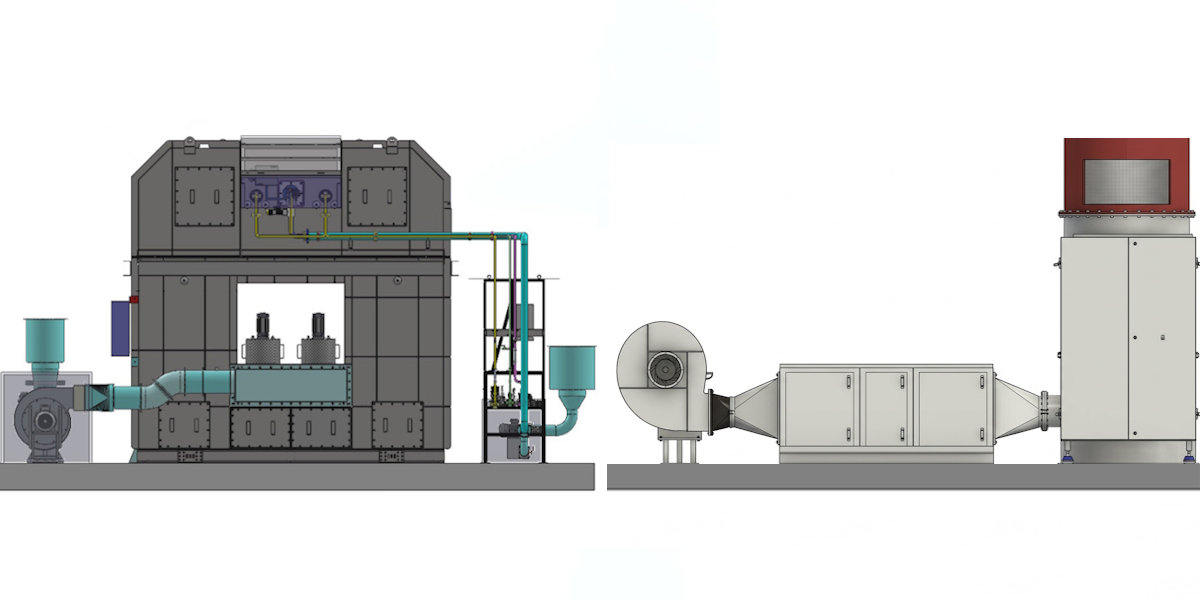
The thermal oxidiser (RTO) is a well-established technology based on conventional chemistry. In this solution, the air stream is heated inside a combustion chamber where high temperatures break the chemical bonds of the target molecules. Through this thermal process, the oxidiser achieves complete mineralisation of the pollutants, converting them into harmless substances such as carbon dioxide (CO2) and water vapour (H2O).
Conversely, cold atmospheric plasma technology is an innovative solution that uses radical chemistry to mitigate odours and reduce VOCs. Unlike traditional thermal systems, the process takes place at ambient temperature and does not treat the entire airflow: the system generates highly reactive Oxygen Species (ROS – Reactive Oxygen Species) inside dedicated modules and injects them into the ductwork to attack odour-causing molecules.
Because it is a cold treatment, the absence of high temperatures prevents the total destruction of the molecules, leading to the formation of by-products that may require subsequent treatment.
Thermal Oxidiser vs Cold Plasma: technical criteria of choice
To identify the most suitable solution for abating pollutants emitted in an industrial context, a thorough analysis of the air stream and the production environment is essential. Below are the main technical parameters influencing the choice between a thermal oxidiser and non-thermal plasma.
Air flow rate and pollutant load
Regenerative Thermal Oxidisers (RTOs) are ideal for air streams with high flow rates and high concentrations, whereas cold plasma technology is better suited to variable flow rates and low pollutant loads. To understand this concept, it is essential to analyse the impact on consumption:
- the RTO can operate in a self-sustaining thermal mode when handling large volumes of air and high VOC concentrations. In this scenario, the system exploits the actual combustion of the pollutants to generate the heat required to maintain the chamber at operating temperature, drastically reducing the consumption of auxiliary fuel;
- non-Thermal Plasma (NTP) technology uses electrical energy to generate the oxygen radicals needed to reduce odours. An excessive pollutant load would compromise the efficiency of the system and significantly increase its energy consumption.
Pollutants to be treated and abatement efficiency
The Regenerative Thermal Oxidiser is mainly used for VOC abatement, while plasma technology is recommended for the reduction of odoriferous compounds. Specifically:
- the high-temperature combustion process of the RTO ensures a Volatile Organic Compound (VOC) abatement efficiency exceeding 99%;
- non-thermal plasma (NTP) technology can achieve and exceed a 90% odour mitigation efficiency. The actual effectiveness is verified through specific on-site pilot tests, where independent bodies sample odour concentrations before and after treatment to certify the mitigation percentage.
Available space
- the indirect cold plasma system (such as AEROX technology) does not need to treat the entire volume of air within a dedicated chamber, but generates active oxygen that is injected directly into the existing ductwork. Furthermore, the plasma generation modules occupy minimal space, making the installation easily integrable;
- Regenerative Thermal Oxidiser (RTO), on the other hand, is equipped with a combustion chamber into which 100% of the gas stream is conveyed and treated. The footprint of this technology is therefore considerably larger than that of plasma technology.
Operating and maintenance costs
The RTO has higher purchase and maintenance costs, whereas plasma technology is characterised by lower initial capital expenditure (CAPEX) and operational expenditure (OPEX). This difference is attributable to the operation of the two technologies:
- starting up an RTO requires significant energy consumption, which is why it is more suitable for use in continuous-cycle contexts. In addition to start-up costs, there is the consumption of compressed air, electricity, and natural gas. However, the latter can be eliminated or reduced when the system operates in a self-sustaining thermal mode;
- cold plasma technology, by contrast, requires low electricity consumption and does not need fossil fuel. Maintenance must be carried out approximately every 10,000 operating hours and mainly consists of cleaning or replacing the plasma modules. These features translate into lower management costs compared to the thermal oxidiser.
RTO and plasma technology compared: advantages and disadvantages
The table below summarises the main advantages and disadvantages of the two analysed technologies.
| Technical parameters | Thermal Oxidiser (RTO) | Cold Plasma Technology |
|---|---|---|
| Abatement efficiency | Over 99% for VOCs and combustible odorous compounds | Odour mitigation up to 95% (variable depending on the nature of the odours) |
| Pollutant concentration | Ideal for high loads (self-sustainment) | Best suited to low concentrations |
| Footprint | Large | Compact |
| Energy consumption | Variable (high at start-up, low during self-sustained combustion) | Low (electricity only) |
| By-products | None (only CO₂ and H₂O) | Possible |
Thermal oxidiser vs cold plasma: which technology should you choose?
As outlined in this article, Regenerative Thermal Oxidisers (RTOs) and non-thermal plasma are not interchangeable solutions, but rather technologies with distinct fields of application. There is no one-size-fits-all choice: effectiveness is strictly linked to the characteristics of the air stream, air volumes, space available and the specific pollutants to be treated.
Selecting the correct technology is essential to protect operator health and ensure emissions comply with current regulatory limits, thereby avoiding fines or production downtime.
Our team of specialists is fully available to support you in this important decision. Contact us today to arrange a targeted technical site survey, during which we will gather the data required to design and build your next tailor-made plant!